What Is Constant Contact Review in 2026 ?
This Constant Contact Review explores the platform’s main features, pricing, benefits, and limitations to help small businesses decide whether it is the right email marketing solution. From campaign creation to marketing automation, Constant Contact offers tools to simplify digital marketing.
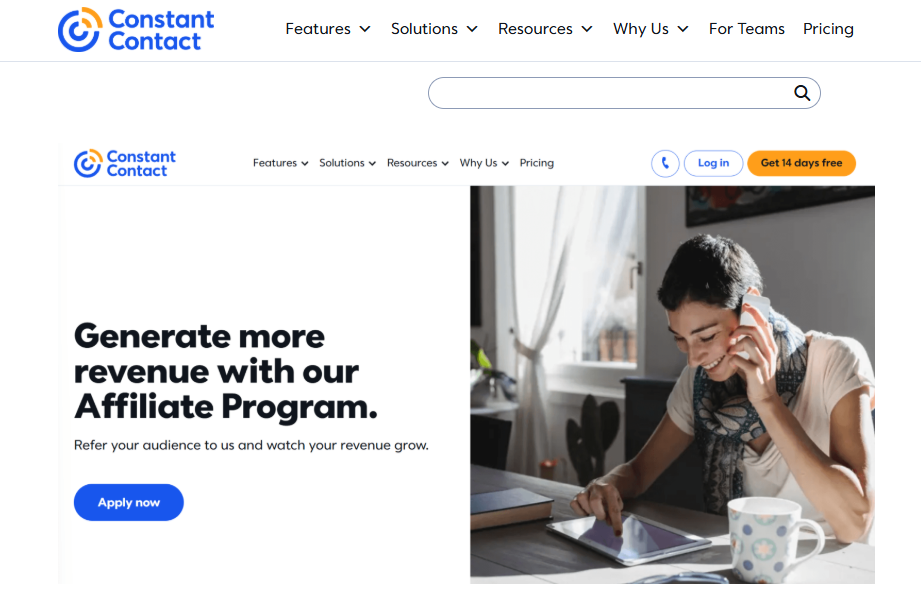
The platform helps users create and send email campaigns, manage contacts, build signup forms, automate marketing communications, publish social media content, promote events, and analyze campaign performance.
Constant Contact has expanded beyond traditional email marketing, offering tools for social media marketing, advertising, automation, events, AI-assisted content creation, landing pages, and integrations. Its current platform offers more than 300 integrations, including connections with services such as Shopify, Salesforce, Canva, Zapier, Eventbrite, and others.
For businesses that want several digital marketing functions in one platform, this broader approach can be useful.
How Does Constant Contact Work?
Constant Contact is built around a relatively straightforward marketing workflow.
You can start by importing or collecting contacts, creating an email campaign, selecting a professionally designed template, customizing the content, and scheduling or sending the campaign.
The platform also allows businesses to create automated campaigns. For example, you can create welcome emails for new subscribers or automated follow-ups based on customer actions. Constant Contact supports automation templates such as welcome series, abandoned-cart campaigns, thank-you sequences, and birthday emails.
The basic workflow looks like this:
Build your audience → Create content → Automate or schedule campaigns → Send → Track performance → Improve
This makes Constant Contact suitable for businesses that want an email marketing system without building their entire marketing workflow from scratch.
Constant Contact Review 2026: Key Features
In this Constant Contact Review, one of the biggest advantages is the platform’s combination of email marketing, contact management, automation, and reporting tools. These features help businesses manage their marketing activities from one place.
1. Email Marketing
Email marketing remains one of Constant Contact’s core features.
The platform includes a drag-and-drop email editor and professionally designed templates that allow users to create campaigns without extensive design or coding knowledge.
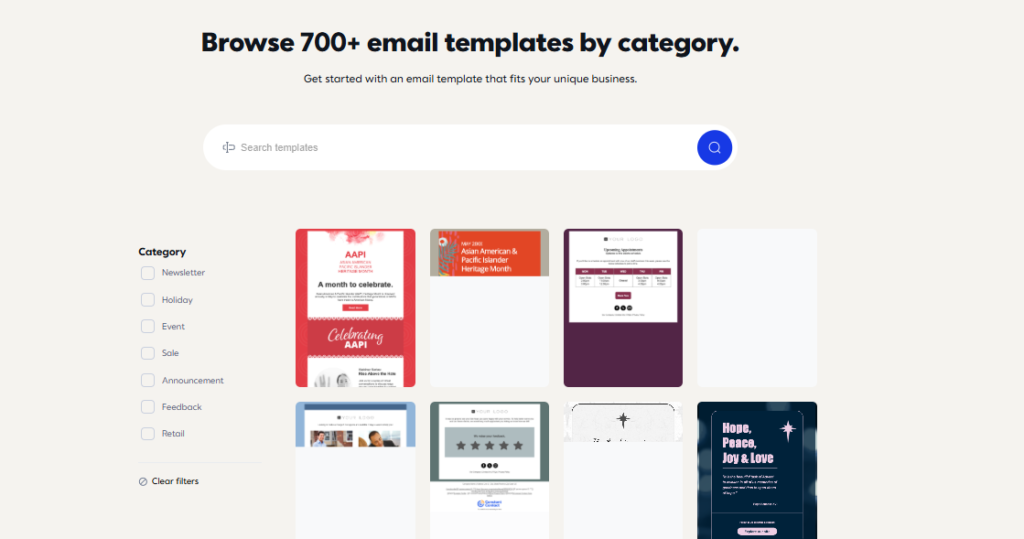
You can create newsletters, promotional emails, announcements, invitations, and other campaigns.
Depending on the plan, users can also access features such as email scheduling, subject-line A/B testing, personalization, dynamic content, and more advanced reporting.
Learn more about [email marketing tools] and how automated campaigns can improve customer engagement and save time.
Why it matters
For small businesses, having templates and a visual editor can significantly reduce the time required to create professional-looking campaigns.
2. AI-Powered Content Creation
Constant Contact has incorporated AI into its marketing tools.
Its AI features can help generate email copy and provide content recommendations. The platform also allows marketers to repurpose email content into social media posts.
This can be particularly useful when you’re struggling to create campaign copy or need to adapt one piece of content for multiple marketing channels.
3. Marketing Automation
Marketing automation is another important part of Constant Contact.
Users can create automated sequences based on customer actions and marketing events. Examples include:
- Welcome emails
- Thank-you emails
- Abandoned-cart messages
- Birthday campaigns
- Follow-up sequences
- Resends to people who did not open an email
Constant Contact also supports behavior-based tagging and segmentation, allowing businesses to create more targeted campaigns.
However, the level of automation available depends on the plan you choose.
4. Contact Management and Segmentation
Managing subscribers is essential for effective email marketing.
Constant Contact provides contact management tools that allow businesses to store and organize contacts, create signup forms, and segment audiences.
Higher-tier plans provide more advanced segmentation capabilities, which can help marketers send more relevant messages to different groups of subscribers.
For example, you could create separate segments for:
- New subscribers
- Existing customers
- Highly engaged subscribers
- Customers who purchased recently
- People who clicked a particular campaign
Constant Contact isn’t limited to email.
The platform includes social media tools that allow users to create, schedule, and publish posts across supported social networks.
This can make it easier for small businesses to manage multiple marketing channels from one platform rather than switching between several applications.
6. Landing Pages and Lead Generation
Growing an email list requires more than simply sending emails.
Constant Contact provides lead-generation tools such as website signup forms and customizable landing pages.
These tools can help businesses turn website visitors into email subscribers.
For example, a business could create a landing page offering a discount or free resource in exchange for an email address. if looking to build an online presence on a budget, check out our guide to the [best free website builders] to find the right platform for your business.
7. Analytics and Reporting
Constant Contact provides reporting tools to help marketers understand campaign performance.
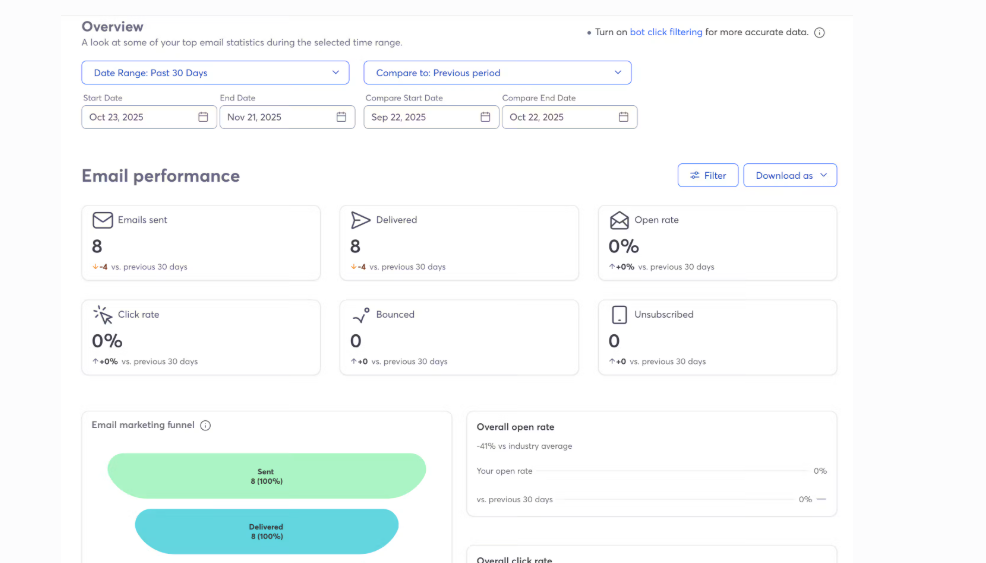
Depending on the plan, reporting can include information about opens, clicks, engagement, and other campaign metrics. Higher-tier plans provide more detailed reporting capabilities.
These insights can help marketers determine:
- Which emails perform best
- Which subscribers are engaging
- Which subject lines generate more interest
- Which campaigns need improvement
8. Event Marketing
One feature that differentiates Constant Contact from some basic email marketing platforms is its event functionality.

Businesses and organizations can use Constant Contact to promote events, manage registrations, and handle certain event-related activities such as payments and selling products or services.
This can be particularly useful for nonprofits, community organizations, consultants, and businesses that regularly host events.
9. Integrations
Constant Contact supports 300+ integrations, allowing businesses to connect their marketing activity with other software and services.
Examples include integrations with:
- Shopify
- Salesforce
- Canva
- Zapier
- Eventbrite
- Microsoft
This broad integration ecosystem can make Constant Contact easier to incorporate into an existing marketing stack.
Constant Contact Pros and Cons
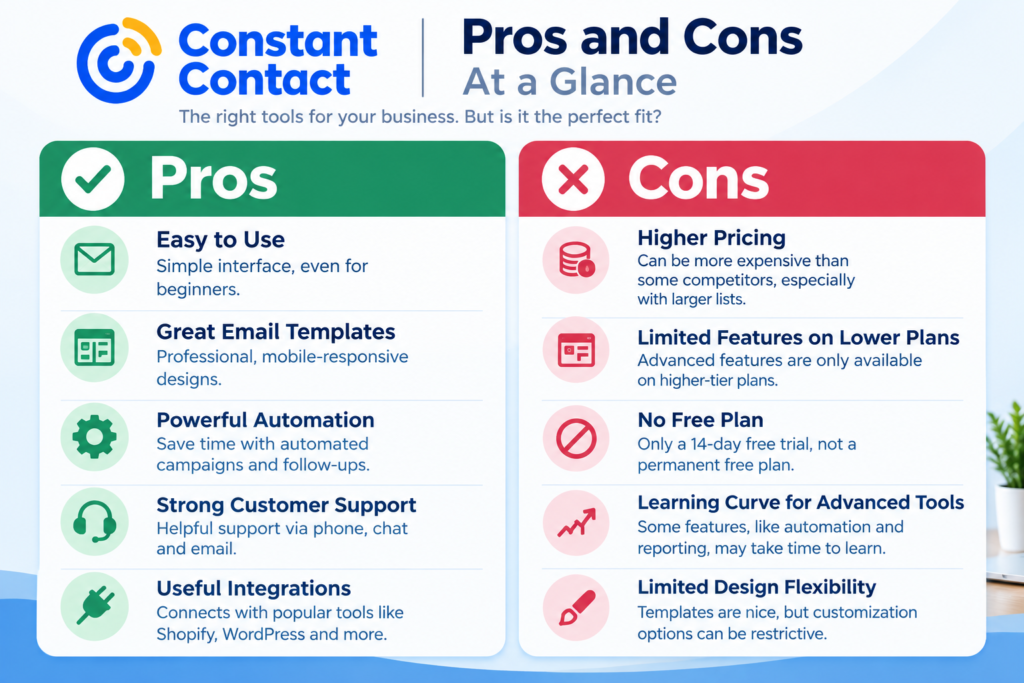
A key takeaway from this Constant Contact Review is that ease of use is a major strength, especially for beginners. However, businesses with growing contact lists should carefully compare subscription costs and available features before choosing a plan.
Constant Contact Personal Experience
From a practical user perspective, Constant Contact appears designed to make email marketing accessible to small businesses and beginners.
The drag-and-drop editor, templates, AI assistance, signup forms, automation templates, and reporting tools provide most of the functionality a small business needs to start email marketing.
The biggest consideration is likely to be cost versus requirements. A beginner who only needs basic email campaigns may not need the higher-tier features. However, businesses that want automation, segmentation, social media tools, event marketing, and integrations may find the broader platform more valuable.
Constant Contact Pricing
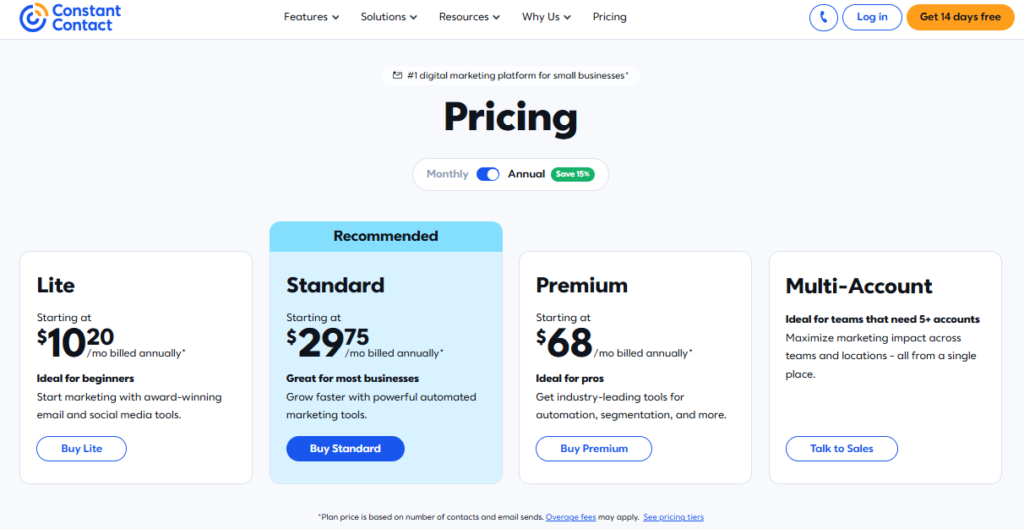
When evaluating the pricing in this Constant Contact Review, consider both your current subscriber count and your future marketing needs. Comparing the Lite, Standard, and Premium plans can help you choose the right balance of cost and functionality.
Constant Contact currently offers three main plans: Lite, Standard, and Premium.
At the current U.S. starting prices, the monthly plans begin at approximately:
Prices are based on the number of contacts, and annual prepayment can reduce the starting prices. Constant Contact currently lists annual starting prices of $10.20/month for Lite, $29.75/month for Standard, and $68/month for Premium.
Is There a Free Trial?
Yes. Constant Contact offers a free trial that allows users to test the platform before committing to a paid subscription.
Is Constant Contact Easy to Use?
Yes, particularly for beginners and small businesses.
One of Constant Contact’s strongest selling points is its emphasis on ease of use.
The drag-and-drop editor, templates, AI assistance, signup forms, and prebuilt automation workflows reduce the technical knowledge required to launch campaigns.
However, marketers looking for highly sophisticated automation workflows may eventually prefer platforms built specifically around advanced automation and customer journeys.
Constant Contact Alternatives in 2026
When comparing alternatives, this Constant Contact Review suggests considering your budget, required integrations, and automation needs. MailerLite, Brevo, and Mailchimp may be worth comparing to determine which platform best fits your marketing goals.
1. Mailchimp
Mailchimp is one of the best-known email marketing platforms and offers email marketing, automation, audience management, and marketing tools.
Best for: Businesses looking for a widely adopted email marketing platform.
2. MailerLite
MailerLite is worth considering if affordability and simplicity are priorities.
Best for: Bloggers, creators, freelancers, and small businesses looking for a straightforward email marketing platform.
3. Brevo
Brevo combines email marketing with other communication tools and can be attractive to businesses that want a broader communication platform.
Best for: Businesses looking for cost-conscious email and messaging tools.
4. HubSpot
HubSpot offers a much broader CRM and marketing ecosystem.
Best for: Businesses that need CRM, sales, marketing automation, and customer management in one ecosystem.
5. ActiveCampaign
ActiveCampaign is particularly well known for marketing automation and customer journeys.
Best for: Businesses that need more sophisticated automation than basic email campaigns.
Current comparison data from Capterra lists EmailOctopus, Omnisend, Brevo, and HubSpot Marketing Hub among Constant Contact alternatives, while also noting that Constant Contact has a 4.3/5 rating from 2,945 reviews on its platform.
Who Should Use Constant Contact?
Constant Contact may be a good fit for:
- Small businesses
- Entrepreneurs
- Nonprofits
- Local businesses
- Consultants
- Event organizers
- Beginners in email marketing
- Businesses that want email and social media tools together
Its combination of ease of use, customer support, templates, automation, integrations, and multichannel marketing makes it particularly attractive to smaller organizations.
Is Constant Contact Worth It in 2026?
Before making a final decision, use this Constant Contact Review to evaluate the platform’s ease of use, available features, customer support, and overall cost. Choosing the right email marketing service depends on the specific needs of your business..
Its strongest advantages are its user-friendly email creation tools, templates, automation, integrations, social media functionality, event features, and customer support.
The main drawback is pricing. As your contact list grows, your monthly cost can increase, and some of the more advanced marketing features require higher-priced plans.
For a small business just getting started, Lite can cover the basics. For a growing business that needs better automation, scheduling, testing, and reporting, Standard is likely the more balanced option. Businesses with sophisticated marketing requirements can consider Premium.
Final Verdict:
Overall, this Constant Contact Review shows that the platform is worth considering for small businesses that value simple campaign creation, useful integrations, and accessible marketing tools. The best choice depends on your budget, audience size, and automation requirements.
It isn’t necessarily the cheapest email marketing service, and advanced users may find more specialized platforms better suited to complex automation. However, its combination of usability, support, integrations, templates, and multichannel marketing makes it a compelling choice for small and growing businesses.
Overall, Constant Contact is best suited to marketers who value simplicity and an all-in-one approach over having the most advanced automation features available.
Constant Contact Rating
| Category | Rating |
|---|---|
| Ease of Use | ⭐⭐⭐⭐⭐ |
| Features | ⭐⭐⭐⭐½ |
| Email Marketing | ⭐⭐⭐⭐½ |
| Automation | ⭐⭐⭐⭐ |
| Integrations | ⭐⭐⭐⭐⭐ |
| Customer Support | ⭐⭐⭐⭐⭐ |
| Pricing | ⭐⭐⭐½ |
| Overall | 4.4/5 |